
IndiGo operator InterGlobe Aviation had a mildly encouraging third quarter in financial year 2026 (Q3FY26).

Around one full month of supply is firmly arranged with additional procurement being continuously finalised, and oil companies are successfully delivering over 5 million cylinders every day.
While prices sustaining lower levels is crucial, Govt actions are also a key monitorable given the forthcoming elections in 2024.

The last year has seen public sector undertakings (PSUs) outperforming the Nifty50, albeit by a small degree. But PSU valuations are still, on average, less than half of private sector peers at price-to-equity or PE 8.7x for the Nifty PSU Index versus 20.9x for the Nifty50. There are several reasons for lower valuation.

India is back on the diplomatic table pushing oil producing countries to raise production in a bid to cool down runaway oil prices. Brent crude oil prices traded above $90 a barrel, on Thursday, for the first time since 2014. Brent is the most popular marker for crude oil trade. It is used as a benchmark for two-thirds of the world's internationally traded crude oil.

Stocks of public sector companies, especially the oil refining and marketing companies (OMCs) - Bharat Petroleum Corporation Limited (BPCL), Hindustan Petroleum Corporation Limited (HPCL) and Indian Oil Corporation Limited (IOC) - logged gains on Tuesday in a weak market. While the Nifty lost nearly 1 per cent in trade on Tuesday, the Nifty CPSE index - a gauge of performance of central public sector enterprises on the National Stock Exchange (NSE) - gained over 3 per cent in intra-day trade. The rally in PSU stocks comes on the back of the BPCL chairman, Arun Kumar Singh suggesting in the company's annual general meeting (AGM) on Monday that the government intends to complete the divestment process in the OMC by March 2022.

More than half of the total subsidy provisioning, amounting to 54 per cent, is going towards food subsidy, which is estimated at Rs 184,220 crore for 2019-20 - a 7.5 per cent increase over the revised estimates for 2018-19.
This will be the highest ever revenue loss or the under-recovery by oil retailing companies in India.

As oil marketing companies (OMCs) stare at huge under-recoveries, India is facing fuel shortage across the country with states like Rajasthan, Madhya Pradesh, Karnataka Uttarakhand, Gujarat and Haryana being the worst hit. The under-recoveries suffered by OMCs are around Rs 20-25 a litre for diesel and Rs 14-18 a litre for petrol, said sources. Government and state-run companies denied reports of any crisis or supply-side issues on the availability of fuel.

Investors are showing some interest in the downstream energy cycle. Refiners and marketers, especially the public sector (PSU) oil marketing companies (OMCs) could see a revival of marketing margins. Lower crude oil and gas prices may also improve margins in industries like paints, logistics, synthetic fabrics, plastics, and fertilisers. In the medium-term, however, there could be a supply overhang affecting OMCs as new refining capacities are scheduled to be commissioned, especially in China, and this may lead to a drop in the refining margins as capacity would be surplus to demand until and unless there's a pick-up in global growth.

India's trade account could come under pressure and there could be an inflation push if crude oil prices remain above the $90 per barrel (Brent) for a prolonged period since India imports over 85 per cent of its oil and roughly 50 per cent of its gas. A rebound in economic activity is bound to lead to higher fuel demand. While India is the third-largest importer of crude, it is a net exporter of refined products, which helps to compensate to some degree.

RBML - the joint venture of Reliance Industries Ltd and supermajor BP - has told the government that fuel retailing for the private sector in India has become unsustainable after market-controlling public sector firms frequently froze petrol and diesel prices at rates way below the cost, sources said. Despite a surge in oil prices, state-owned Indian Oil Corporation (IOC), Hindustan Petroleum Corporation Ltd (HPCL) and Bharat Petroleum Corporation Ltd (BPCL) first froze petrol and diesel rates for a record 137 days beginning early November 2021 when five states including Uttar Pradesh went to the polls, and last month again went into a hiatus that is now 47 days old. "They (Reliance BP Mobility Ltd) has written to the petroleum ministry over the fuel pricing issue," a highly placed source in the government, who didn't want to be quoted, told reporters.
BPCL is a high revenue-earning public-sector undertaking (PSU) and plans to privatise it are completely off the table, Petroleum and Natural Gas Minister Hardeep Singh Puri said on Tuesday after assuming charge of the ministry for the second time. "Why would we divest ourselves of highly successful Maharatnas like BPCL," Puri said, arguing the Centre was not in favour of divesting its stake in oil PSUs.
With the government reducing the net worth for new entities in fuel-marketing space to Rs 250 crore, the market is open for new players like Total, Adani, and Saudi Aramco -- and even supermarkets - to open fuel outlets.

Metal stocks also had a good session, with JSW Steel zooming by 7%, and Tata Steel and Nalco gaining about 3% each.

The S&P BSE Sensex and the Nifty50 have hit record highs amid the poll outcome-triggered bull frenzy at the bourses. Most analysts feel that the indices are on course to rise further over the next few months - till the general elections - albeit amid intermittent corrections - largely triggered by global developments. Bharatiya Janata Party's (BJP's) win in the three state elections of Madhya Pradesh (MP), Rajasthan and Chhattisgarh, analysts at Jefferies believe, reinforces the consensus expectations of a Modi win 2024 national elections with a greater likelihood of over 300 seats for the BJP.

Despite multiple headwinds at the start of 2023, the Indian markets delivered a strong performance, posting 19-20 per cent growth for the year. Even as new records were set, investor sentiment remains strong going into 2024, given the lower inflation, expectations of steady to lower interest rates, higher economic growth, and strong inflows. However, the overriding concern for most brokerages is valuations.

Re-instatement of 5% custom duty on crude imports will help.

'There exists a 'brotherhood' of sorts for a very long time and corrupt dealers and corrupt OMC officials are in it together,' Ashwani Attrish, founder, Empowering Petroleum Dealers Foundation, tells Sudhir Bisht, a veteran of the petroleum industry.

The three oil PSUs have told Air India that if it did not make the monthly lump sum payment, they will stop fuel supply from October 11 at six major domestic airports.

The S&P BSE Sensex has gained 149 points to open at 25,802.
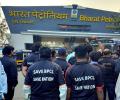
The divestment of Bharat Petroleum Corporation (BPCL) may hit a fuel price hurdle, according to officials dealing with the matter. They pointed out that the inconspicuous administered price regime could hamper the prospects for potential buyers of BPCL. A senior oil ministry official said public-sector oil-marketing companies (OMCs) take a hit when they sell petrol, diesel, and liquefied petroleum gas (LPG), three of the most popular petroleum products in the country.

Prices of petrol were reduced 32 times and increased 21 times while diesel prices were slashed 19 times and raised 28 times since 2013.
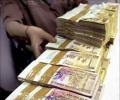
In early trade on Monday, the rupee fell to 63.33 to a dollar, its weakest since September 18.
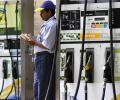
I admire Kejriwal's intelligence but pity the fact that he had to use all the ingenuity and scheming to achieve his revenue enhancement goal, says Sudhir Bisht.
IOC, BPCL and HPCL on Thursday afternoon stopped ATF supplies to Air India at six airports - Kochi, Pune, Patna, Ranchi, Vizag and Mohali - over payment defaults. AI flights from these places were tanking up from other airports.

For the seven months since February 2014, the benchmark index surged nearly 27%.

The rupee weakened to 62.58 against the US dollar in the early trade on Thursday.
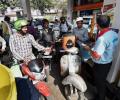
Credit card payments to buy fuel at petrol pumps will from October 1 not get a 0.75 per cent discount that State-owned oil companies had introduced more than two-and-a-half years back to promote digital payments.

The RBI has hiked repo or short-term lending rate up by 0.25 pc to 7.75 pc.

A bonus is given to existing stockholders in proportion to the number of shares they already hold.

Lack of clarity on the overhaul of the subsidy-sharing mechanism by upstream companies.
Asian shares ended higher after a string of positive US economic data.
Brokers said a flurry of buying by investors in blue-chips mainly influenced the sentiment.

The fuel reforms are a very important signal of the government's commitment to tough economic reforms.

Infosys, Tata Motors, ONGC, TCS and GAIL are the top 5 losers.
Markets extended losses to end 1.5% down on Tuesday, amid weak global cues, after investors turned cautious ahead of key economic data and booked profits in rate sensitive shares while the further fall in the rupee continued to weigh on investor sent.

Weak GDP data and unfaouvrable global data has pulled down Sensex, Nifty.
